
Your home’s electrical system is something you rely on every day, but how much do you know about the unit that helps keep it running safely?
A fuse board, or consumer unit, is a vital part of your home’s electrical installation. It distributes electricity to different circuits throughout the property and contains protective devices that help reduce the risk of electrical hazards, including those caused by faults and overloads. Understanding how your fuse board works can help you recognise its key components, identify potential warning signs, and know when to seek professional advice.
In this homeowner’s guide to understanding your fuse board, we explain what a fuse board does, how its components work, and when you may need to consider an upgrade.
Key Takeaways
A fuse board has two primary functions: distributing electricity to different circuits around your home and disconnecting the supply when certain electrical faults occur.
If your fuse board trips, check which areas have lost power, unplug recently used appliances if safe to do so, and contact a qualified electrician if the breaker trips repeatedly.
Repeated tripping, burning smells, unusual noises, or visible damage can indicate electrical faults or overheating. BETEC Electrical Contractors can provide professional advice and electrical services to help keep your home’s electrics safe.
What Does a Fuse Board Do?
Your fuse board has two primary functions: distributing electricity around your home and helping protect your electrical installation when a fault occurs.
1. Distributing Electricity Around Your Home
Electricity enters your property from the mains supply and passes through the fuse board, which distributes it to individual circuits. These circuits supply different parts of your home, such as lighting, plug sockets, and high-power appliances, including electric cookers and showers. Separating the supply into circuits allows different areas and appliances to receive the electricity they need.
2. Protecting Against Electrical Faults
A fuse board also contains protective devices designed to disconnect the electricity supply when certain faults occur. For example, a circuit breaker can trip if a circuit becomes overloaded or develops a short circuit, while a residual current device (RCD) detects certain electrical leakage faults that could cause an electric shock.
These protective devices are essential for household electrical safety. By disconnecting the supply when a fault is detected, they help reduce the risk of electric shock, electrical fires, and damage to equipment.
However, fuse boards cannot prevent every electrical hazard, so a properly maintained installation and professional inspections remain important.
Understanding the Components of a Fuse Board
Although fuse boards vary in design, the following table explains the main components you may find in your home and how to recognise them.
| Component | Where to Find It / How to Identify It | What It Does |
|---|---|---|
| Main switch | Usually a larger switch near the top or side of the consumer unit, often labelled MAIN SWITCH with ON and OFF positions. | Controls the electricity supply to the installation or the circuits it serves, allowing the supply to be isolated when required. |
| Miniature circuit breakers (MCBs) | Usually arranged in a row, with small toggle switches and ratings such as B6, B16, B32, or B40 printed on the front. | Protect individual circuits against overloads and short circuits by automatically disconnecting the supply when excessive current flows. |
| Residual current devices (RCDs) | Often wider than standard circuit breakers and usually identifiable by a test button marked T or TEST. | Detect certain electrical leakage faults and disconnect the supply to help reduce the risk of electric shock. One RCD may protect several circuits. |
| Residual current circuit breakers with overcurrent protection (RCBOs) | Often resemble individual circuit breakers but may include a test button and additional markings indicating their protective functions. | Combine the functions of an MCB and an RCD, protecting an individual circuit against overloads, short circuits, and certain electrical leakage faults. |
| Surge protection device (SPD) | May appear as a separate module within the consumer unit, sometimes with a coloured indicator window. Its appearance and position vary by manufacturer. | Helps protect electrical equipment by limiting transient overvoltages and diverting surge current, reducing the risk of damage caused by voltage surges. |
| Circuit labels | Usually printed or handwritten beside or beneath the switches, sometimes on a separate schedule attached to the consumer unit. | Identify which areas, sockets, lighting, or appliances each circuit supplies, making it easier to determine which circuit a switch controls. |
Not every fuse board contains all these components, as the arrangement and protective devices vary between installations. If you’re unsure which components your consumer unit contains or whether it provides appropriate protection, a qualified residential electrician like our team at BETEC can identify them and assess the installation.
Older Fuse Boards vs Modern Consumer Units
Older fuse boards and modern consumer units both distribute electricity around your home, but they differ in how they protect your electrical installation and what happens when a fault occurs.
Older fuse boards often use rewirable fuses. If a fuse blows, the fuse wire must be replaced with the correct type and rating before the circuit can be used again. Older installations may also lack some of the additional protective devices found in modern consumer units.
Modern consumer units typically use MCBs, which automatically switch off when an overload or short circuit occurs. Once the cause has been identified and safely addressed, a tripped breaker can usually be reset without replacing any components. Depending on the installation, modern units may also include RCDs, RCBOs, and SPDs to provide additional protection against electrical hazards.
These differences can make modern consumer units more convenient to use and offer a wider range of protective features. However, an older fuse board is not automatically unsafe simply because of its age. Its condition, the protective devices fitted, and the overall safety of the electrical installation are all important considerations.
What Should You Do if Your Fuse Board Trips?
A tripped circuit breaker usually indicates that a circuit has experienced a fault or drawn more current than it should. This causes the breaker to switch off the electricity supply to help protect the electrical installation.
If your fuse board trips, follow these steps to help identify the problem safely:
- Check which areas have lost power: If only certain lights or sockets have stopped working, the issue may be limited to one circuit. If the whole property has lost power, check whether your neighbours are affected, too, as there may be a wider supply issue.
- Unplug recently used appliances: If it is safe to do so, unplug appliances that were in use when the power went off. A faulty appliance could be causing the circuit to trip.
- Check for warning signs: Before considering resetting a breaker, look for signs of damage, unusual heat, burning smells, or scorch marks. If you notice any of these, do not attempt to reset it.
- Only reset the breaker if it is safe: If there are no warning signs and you have addressed the likely cause, you may be able to reset the breaker in accordance with the manufacturer’s instructions.
- Contact a qualified electrician if it trips again: If the breaker trips repeatedly, leave it switched off and arrange for a qualified electrician to investigate the cause.
Repeated tripping should never be ignored. It can indicate an underlying electrical fault that needs professional attention. Avoid repeatedly resetting the breaker, as this will not resolve the cause of the problem and could leave a potentially dangerous fault unaddressed.
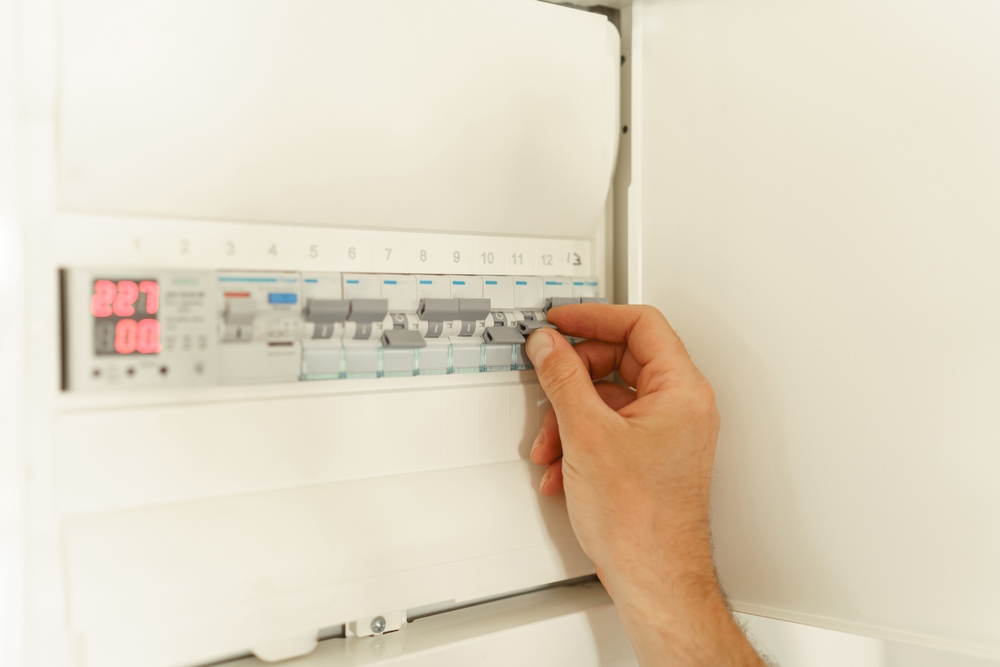
Signs Your Fuse Board May Need Attention
Your fuse board should be checked by a qualified electrician if you notice signs of damage, unusual noises, or recurring electrical problems. Identifying potential issues early can help reduce the risk of electrical faults and keep your home’s electrical installation safe.
Warning signs to look out for include:
- Repeatedly tripping circuit breakers: If a breaker trips regularly, there may be an underlying electrical fault or an issue with an appliance.
- Burning smells, buzzing, or crackling: Unusual smells or noises coming from your fuse board can indicate a loose connection, an electrical fault, or overheating.
- Visible scorching or heat damage: Discolouration, scorch marks, or melted plastic may indicate excessive heat and require urgent attention.
- Damaged or loose components: Broken switches, damaged wiring, or loose components should be assessed by a qualified electrician.
- An older installation with unclear protective arrangements: If your fuse board has not been assessed for many years, or you are unsure whether it has appropriate protective devices, an electrician can check its condition and identify any necessary improvements.
If you notice a burning smell, scorching, or other signs of overheating, treat the situation as urgent. Do not touch the affected equipment or attempt to reset the breakers. If there is smoke or a fire, evacuate the property and call 999. Otherwise, keep away from the affected fuse board and seek urgent professional advice.
Never remove the fuse board cover or attempt internal repairs yourself. Even when the main switch is off, some internal components may remain live. A qualified electrician can inspect the installation, identify the cause of the problem, and advise on the safest course of action.
When Should You Consider a Fuse Board Upgrade?
Renovations, extensions, or the addition of high-demand appliances, such as an electric vehicle charger or an electric shower, can change your home’s electrical requirements. In these situations, it’s worth seeking advice from a qualified electrician to determine whether your existing fuse board can safely accommodate the changes.
A fuse board upgrade may also be necessary if the equipment is damaged, the protective arrangements are unsuitable, or the installation no longer meets your property’s electrical needs.
A professional inspection can help determine whether your existing fuse board remains suitable or whether repairs, improvements, or a replacement are recommended.
Also read: Light Bulbs Explained: How to Choose the Right Bulb
Keep Your Home’s Electrics Safe With BETEC
BETEC, electrical contractors in Guildford, has been providing electrical services since 1990, bringing decades of industry experience to projects of all sizes. As a NICEIC-accredited contractor, BETEC is independently assessed to help ensure our work meets recognised standards for safety and quality.
Also read: What Is NICEIC Accreditation?
Whether you’re looking to improve your existing electrical installation, or need professional advice about your property’s electrical requirements, BETEC takes a practical approach tailored to your needs. Our team prioritises reliable workmanship, clear communication, and solutions designed to serve your property well into the future.
“We know that homeowners don’t always know where to start when it comes to their electrics. At BETEC Electrical Contractors, we’re here to provide clear, practical advice, whether you’re concerned about an existing fuse board or planning electrical improvements, so you can make informed decisions about your home,” says Jamie Hicks, Director
Serving homeowners and businesses across Surrey and London, BETEC is on hand to help you plan your next electrical project confidently.
Contact BETEC Electrical Contractors to discuss your requirements and request a free, no-obligation quote.